
Risk/reward & R-multiples
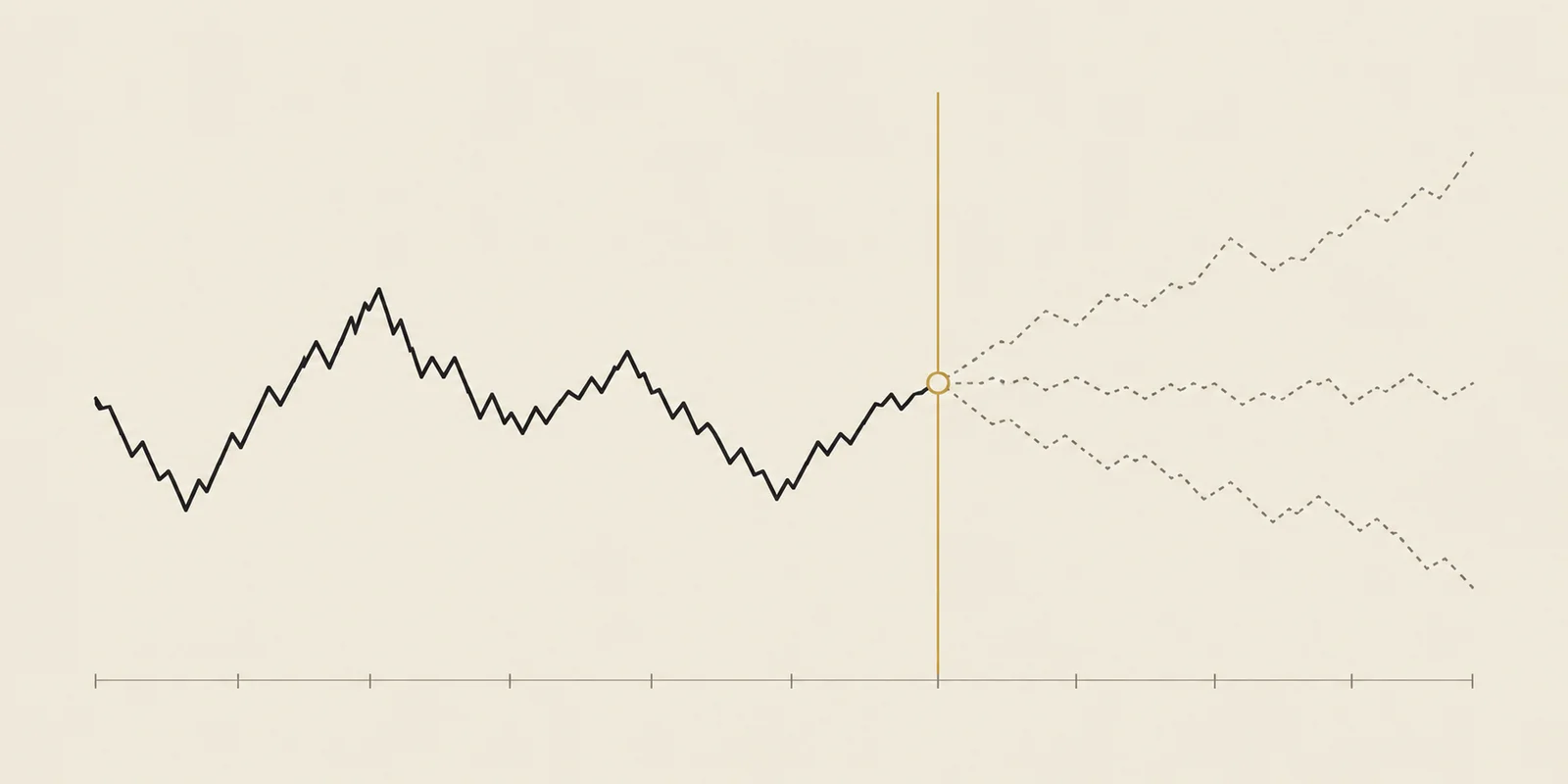
A trade’s entry, safety exit and target let you compare its planned loss with its potential gain.
Read the guide →
A track record describes trade outcomes, account growth and the losses along the way. We’ll work through the metrics in that order, then check the sample and assumptions behind them.
Suppose a strategy wins 11 of 20 trades. That gives it a 55% win rate. To decide whether the result was profitable, you still need the size of those wins and the nine losses. To understand the account’s experience, you also need the order and size of its positions.
The questions below provide a reading order for the panel. Keep the same sample and cost assumptions when comparing metrics.
Win rate is the number of profitable completed trades divided by all completed trades, expressed as a percentage. Eleven profitable trades out of 20 gives 11 ÷ 20 × 100 = 55%.
The calculation counts a small profit as a win just as it counts a large profit. A 55% win rate therefore leaves an essential question unanswered: how much did each side gain or lose?
Profit factor divides total gains by the absolute value of total losses. If an illustrative record gains $1,500 on winning trades and loses $1,000 on losing trades, its profit factor is 1.5. Gains exceeded losses by $500 before any costs omitted from that record.
Average R, also called expectancy or expected R, adds the completed results in risk units and divides by the number of trades. If 20 trades total +6R, average R is +0.3R. Here “expected” refers to a historical average, so a new trade may finish very differently. The R-multiple guide explains the unit.
Keep the units consistent. Setup-card profit factor uses gains and losses in R. Autopilot and live-account reports use dollars. Profit factor above 1 and positive average return should agree when they use the same trades, units and treatment of costs.
The average can conceal an uneven distribution. These additional measures help you see whether many trades contributed or a few large outcomes dominated.
Consider two illustrative records with ten wins and ten losses. If the wins average $150 and losses average $100, the net gain is $500 before costs. If wins average $60 against the same $100 losses, the net result is a $400 loss. Both records have a 50% win rate.
An even higher win rate can have the same problem. Nine gains of $100 total $900; one loss of $1,500 leaves a $600 loss overall. The 90% win rate accurately counts the wins, but says little about their value.
Return to the 11 wins out of 20 in the introduction. You can now evaluate the record by adding the gains and losses, calculating profit factor, and examining how much each trade risked.
Cumulative return measures the account’s total change over the test. An account growing from $10,000 to $40,000 has a +300% cumulative return. A longer test has more time to compound, so compare the dates as well as the percentage.
CAGR, the compound annual growth rate, is the constant annual rate that would connect the starting and ending account values over that period. For example, doubling over ten years corresponds to about 7.2% annually. The actual yearly returns can vary substantially.
TradingPal’s setup-card account uses about 1% planned risk per trade before caps, up to 16 positions, a 20% per-name limit and a 95% gross-exposure limit. It selects a representative path from 25 allocation runs. The methodology guide explains why entry ordering can change compounded returns.
Card records retain the 25th- and 75th-percentile return paths; Autopilot retains the 10th, median and 90th-percentile CAGR paths. Those ranges show the effect of allocation choices within the historical sample.
A drawdown measures a decline from an account peak. An account falling from $100,000 to $80,000 has a 20% drawdown, even if it later recovers. Maximum drawdown is the deepest recorded fall on the reported account path.
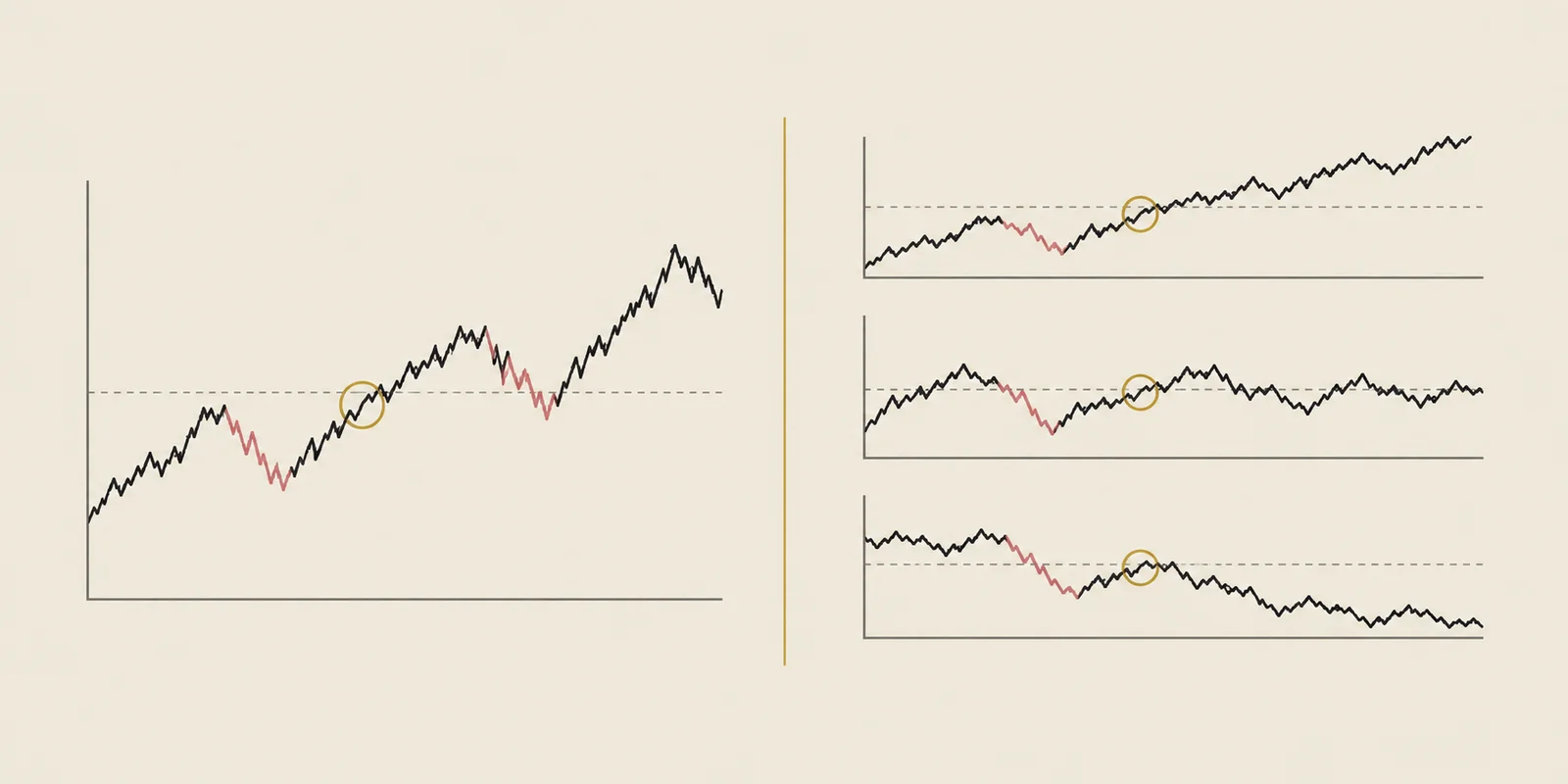
To examine other possible sequences, TradingPal resamples blocks of about 15 consecutive observed trades. Some blocks appear more than once and others are omitted. This procedure, a block bootstrap, produces synthetic histories while retaining some of the clustering in the original trades. Cards use 200 to 2,000 paths depending on sample size; Autopilot uses 2,000.
If the 95th-percentile drawdown is 28%, about 95 out of every 100 sampled paths had a maximum drawdown of 28% or less. These are rounded proportions of simulated paths. The result helps examine position size under stress, but it cannot assign a 95% probability to a future account staying within that loss.
Average hold measures how long completed positions stayed open, in calendar days. It helps you understand the commitment of time and capital associated with the record.
Check the trade count and the number of symbols. More observations can make an estimate more stable, but trades triggered by the same market event are related. A thousand trades concentrated in one period provide different evidence from a thousand spread across many conditions.
The test’s start and end dates identify the market history. The last-run date tells you when the record was calculated. Read those alongside the methodology, including costs, selection rules and portfolio limits.
A profitable collection of trades can be difficult for one account to capture. These measures show how often positions compete for cash or remain open while new opportunities arrive.
Review when and where the gains occurred. A result concentrated in one year or pattern family may depend heavily on conditions that were present in that sample.
The table below reports TradingPal’s latest completed pattern simulation. Compare win rate with average R and sample size, then open the full record for account return, drawdown and the test period.
Apply the same questions used in the worked examples: did the gains cover the losses, were they broadly distributed, and could the account hold the trades that produced them?
| Pattern | Usual break | Win rate | Avg return | Backtested trades | Fresh (45d) |
|---|---|---|---|---|---|
| Bullish pennant | Up | 54.5% | +3.6% | 6,817 | 86 |
| Bearish pennant | Down | — | — | — | 0 |
| Ascending triangle | Up | 48.9% | +2.6% | 1,753 | 19 |
| Descending triangle | Down | 48.9% | +2.6% | 1,753 | 6 |
| Symmetrical triangle | Either way | 48.9% | +2.6% | 1,753 | 80 |
| Falling wedge | Up | 44.3% | +2.9% | 1,149 | 60 |
| Rising wedge | Down | 52.0% | +1.6% | 390 | 9 |
Historical results of a simulated strategy, refreshed nightly. Triangle rows show their usual break direction's family; each guide breaks out both directions.
The track-record panel below brings these measures together for the selected pattern family. Its trade statistics and simulated-account statistics refer to different parts of the analysis, so check the label and unit of each value.
A stock-specific badge can use a narrower sample than the family panel. Before comparing the two, check which stock, pattern, direction and historical period each one covers.
Not a screenshot — this is the real panel from the screener, populated from the latest completed stored nightly result.
There is no universal good win rate. A 50% record can make or lose money depending on average win, average loss, and costs. Judge it with payoff ratio, average R, profit factor, sample size, and the rule that produced the trades.
Gross gains divided by the absolute value of gross losses in the record's native unit—R for setup cards, dollars for Autopilot and live-account reports. Above 1 is historically positive before any costs the record does not model; below 1 is historically negative.
One is the historical break-even line before unmodeled costs. How much margin above 1 is convincing depends on sample size, market regimes, execution assumptions, and whether a few outliers supplied most of the gains. Read the full distribution rather than using one universal grade.
Your average result per trade. Setup cards add results in R and divide by completed trades; Autopilot and live-account dollar expectancy divide net dollar P&L by completed trades. A positive historical average across a large, broad sample is evidence of an edge under that record's rules and cost assumptions.
Yes — win nine trades at $100 each and lose $1,500 on the tenth, and you're down $600 with a 90% win rate. A small number of very large losses can outweigh many smaller wins.
TradingPal samples contiguous blocks of observed trades with replacement to build 200 to 2,000 synthetic paths, depending on the record. The p95 max-drawdown number is the level that 95 out of 100 sampled paths stayed at or below; about 5 out of 100 were worse. It is a stress-planning threshold, not a promise or a conventional 95% confidence interval.
Higher means more historical return per unit of measured volatility, but no cutoff is good in every context. Read Sharpe with the backtest length, bootstrap drawdown, cost assumptions, and Probabilistic Sharpe confidence check because a short or selected sample can make it look better than the underlying edge.
A trade’s entry, safety exit and target let you compare its planned loss with its potential gain.
Backtesting applies a trading rule to historical prices and records the simulated outcomes.
A setup’s trade history and an account’s return answer different questions.
A bullish pennant forms when a sharp rally pauses in a small, narrowing range.
Educational content, not investment advice. Backtest statistics are historical results of a simulated strategy. Publication timing varies by record; the numbers describe the past, not the next trade.